“Dad in the 90’s” in Review

Uncategorized

504.246834.1019058_thumb

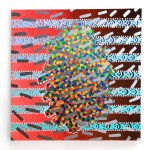
Katherine Wagner’s Dad in the 90’s (a painting in our Otherworldliness show), is a synthesis of past and present.  A piece of found material supplies a foundational structure, an armature for a meditation on past experiences.  Inspired by textile and its ability to conjure the past, through palette and pattern, Wagner searches for fabrics that connect with an aspect of familiar associations. Using the found rhythms and structures within the textile, Wagner composes her own rhythm, adding shapes, colors, and disruptions, stitching pieces together, creating a wholly new composition. This piece speaks to a memory of a pair of swim trunks owned by her father back in the day- a cause for embarrassment at the time.  This piece seems to connect with that memory in a way that is more emboldened, an act of looking back on this aesthetic decision as a noteworthy moment in an inherited visual vocabulary.

by Amanda Joy Brown

Close/Open/Review

Uncategorized

Join us this Thursday night 5-8pm for a casual Closing Show/Open Studios where you can visit with art, artists and works in progress. Light snacks and yummy beverages provided.

In the meantime please see below for the review of Hot Water, an acrylic painting by Brianna Bass, written by another Otherworldliness artist, Katherine Wagner, and consider finding the perfect, small space for it in your home. This “world” reads big, but only measures 12” x 12” x 1.5″ and is really quite affordable. Hot WaterBrianna Bass’ painting Hot Water, on wood cradled panel, is visually guarded with strong vibrating colors that separate into different levels. Although the composition is cellular, seemly a place for your eyes to rest, you get bounced back outside of the cell to wander through the depths of a psychedelic, molecular world. This sensation of unrest relates to the title of the piece. Hot water can both burn and soothe bouncing between the two like the push and pull on the panel, bolstered through the use of pattern. The directional light, layered patterns, and color interplay all seem well thought out which leaves me wondering about the use of wood panel and how it relates to the rest of the work. Is it the pattern of the wood that allowed for the jump to exploring repetition in paint? Or maybe it is purely a support system for the piece. Either way, the piece is entrancingly busy and rich. Brianna Bass has created a world that I would hesitantly enter but gladly observe through the window she has provided.

Review of Andrew O’Brien’s Photograph by Robert Fields

Uncategorized

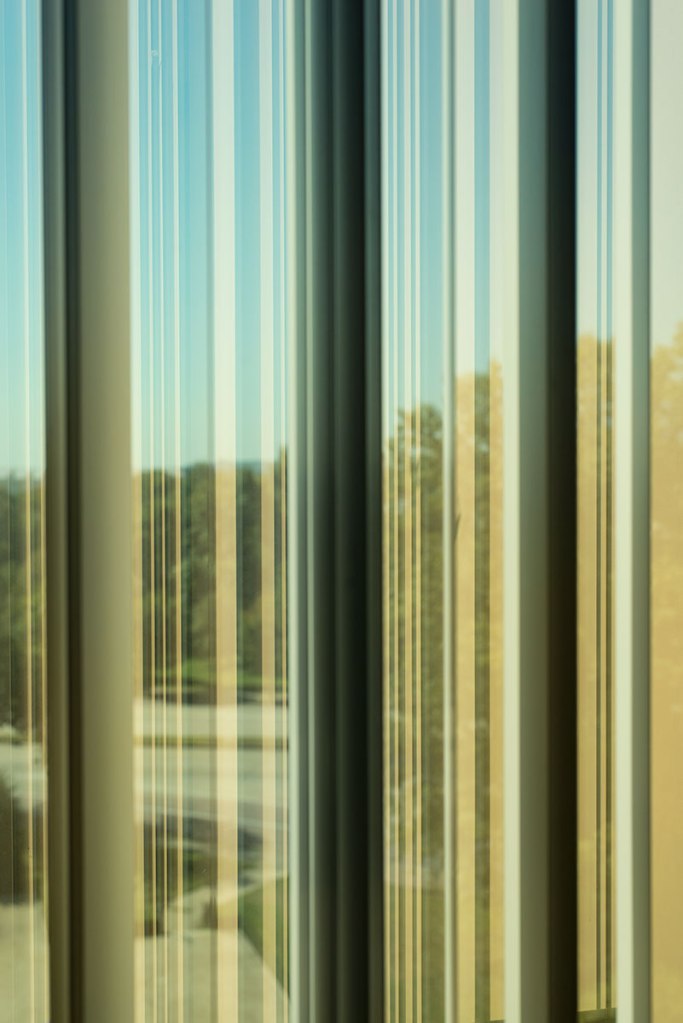
Now, nearly a week after seeing Andrew O’Brien’s untitled photograph… it remains a still & quiet reflection. 

What I first saw was a random array of vertical bands: thick, thin, solid to nearly transparent…a landscape sliced… which I had to linger over, and work at reading: near, middle and far. 

What’s unseen is the broader context in which to understand where I am standing.  What am I seeing, looking at or through? What’s real or am I imagining more than what’s there? Inside? Outside? 

What would be good to see in addition to this marvelous print… are the other photographs from his Curtain Wall Series, all side by side. Go to aophoto@gmail.com .

What I experienced from viewing O’Brien’s “untitled” was the sense of peering through another artist’s picture-window created by the narrow, white frame…a view into a mystery-chamber… a dream of time and place, trapped… encapsulated between triple, transparent plates.  

Can I now let it go? Do I? Maybe better asked: When will these thoughts and impressions let go of me?

~Bob Fields/ 4.17  

Gallery Hours for the month of April: Tuesdays and Thursdays 5-8pm or call to schedule private viewing.

Otherworldliness

Uncategorized


Our 5th Annul Juried Show opens this Saturday, April 1st from 6-9pm. Join us for a gallery talk with curator, Austin Thomas, and meet with the artists in attendance.

Congrats to those chosen for Otherworldliness: Frances Ashforth, Brianna Bass, Robert Fields, Gil Given, Carl Gombert, Kathia St. Hilaire, Amanda Joy Brown, Elysia Mann, Dusty Mitchell, Andrew O’Brien, Katherine Wagner, Mariel Zuchman.

“Otherworldliness” – Ground Floor Gallery, Nashville, Tennessee

March 27 – April 28, 2017, curated by Austin Thomas

Curatorial Statement

This exhibition presents examples of many typologies with an emphasis on artists from Nashville, other parts of Tennessee and elsewhere with photography, painting, printmaking and sculpture.  I have chosen painterly work with a focus on what I believe represents a feeling of otherworldliness.  There is a painterly vibe in the exhibition.  Some of the works are almost divine.  And the overall choices are not devoid of political content.

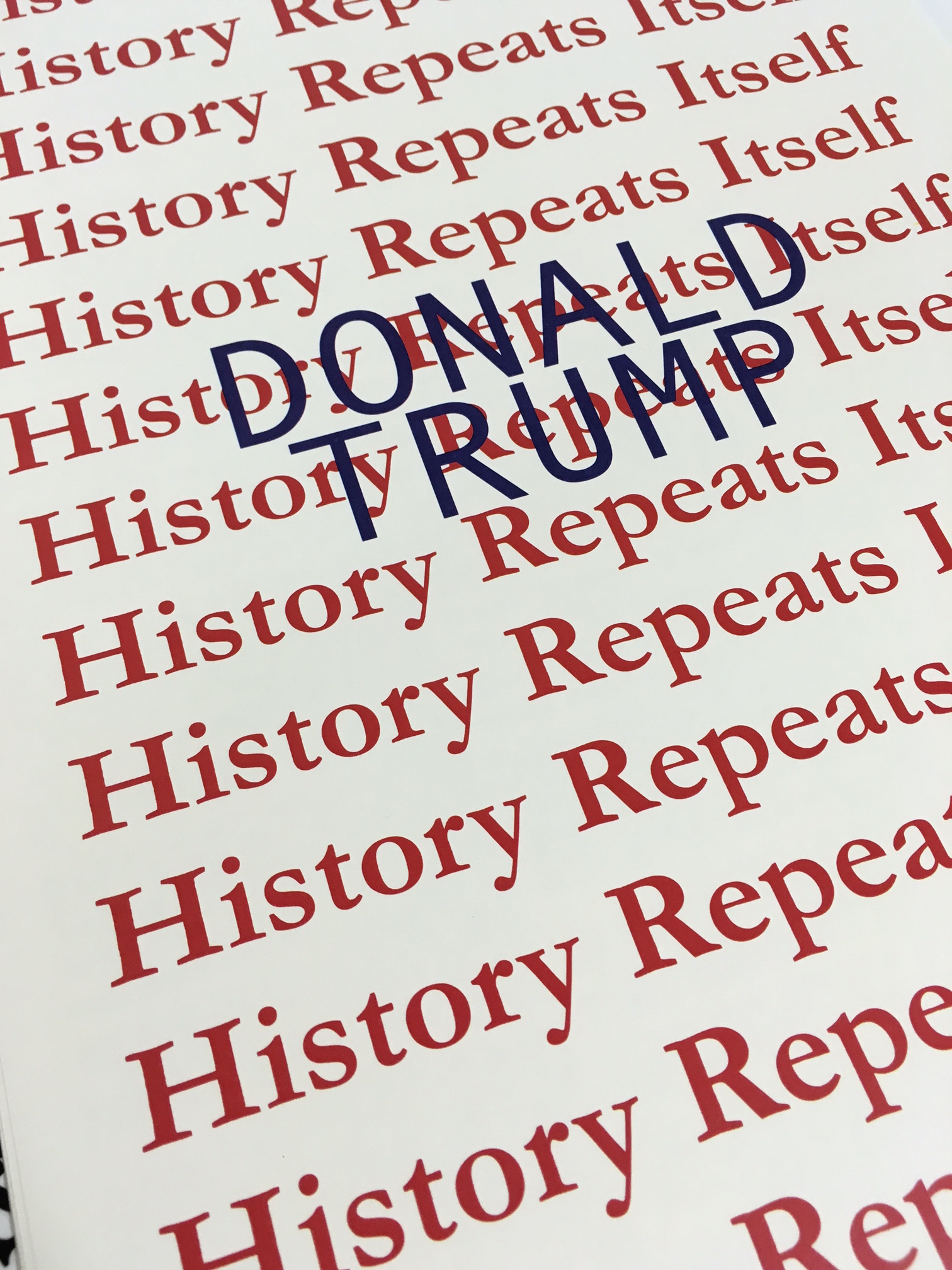
Whether painterly or politically-titled, as in Robert Fields’ piece (“Let it be an arms race.” — Donald Trump), all of the participating artists are present in the timeless inner territory that is of the artist where one attempts to build upon understanding and knowledge to expand meaning.

Frances Ashforth affirms our desire for an inner landscape as she teaches us through her monotypes about water and its importance in our lives.  Ashforth’s work, represented in this exhibition with a unique water-based monotype titled “Playa 7,” is bathed in blue, revealing to us the spirit of nature itself.  Nature is powerful and we are its student.

As students, we take notes and have homework. Mariel Zuchman’s watercolor and pastel artwork is a lesson in the transformative power of thinking and making visual thoughts on paper. Zuchman may make art to visually understand her thoughts.

Small ideas render deeper meaning in Carl Gombert’s kaleidoscopic rubber-stamped drawings.  His themes, motifs and symbols are set to repeat and his images reveal patterns with each color and stamp change.

Using one color and repurposing one material, black rubber, Dusty Mitchell’s piece cleverly hit the mark with our #MakeAmericaArtAgain call. His work serves as an awesome entrance into our “otherworld” as he has literally put out a welcome mat cut in the shape of the United States, but please don’t wipe your feet on your way in.

Gil Given’s three dimensional “sculptural painting” may challenge preconceived notions of traditional painting on canvas because his work of rainbow-colored acrylic paint on wood and canvas may propel itself off the wall, play a tune and dance out the room!  Gil Given is an artist marching to his own drummer, as they say.

More quiet is Elysia Mann’s hand-printed rope ladder “Anteroom” which seems to hang over a wall intended to keep someone in rather than carry someone out to safety.  Mann is also a poet and weaver unifying word and image together not unlike the centuries old Arabic practice of weaving the Koran into poems, called Iqtibas.

Kathia St. Hilaire’s relief print “Style,” weaves together a connectedness of personal history with communal memory into a powerful narrative reaffirming her rich present.

Andrew O’Brien’s untitled photograph from his curtain wall series reveals the appealing apparent transparency of glass.  In O’Brien’s photograph the outside world seems so far away.  His image is one of isolation.  But we are not concerned for in this exhibition, organized around the theme of otherworldliness, we have some exuberant painting ¾ represented in the works of Brianna Bass, Amanda Brown and Katherine Wagner.  This is a diversified collection of work demonstrating the mental labors of the discipline.

Brianna Bass’s painting “Hot Water” is so filled with different patterning that it feels like it is expanding and contracting at the same time.  The colors Bass uses revive and restore the transformative power of art itself.

A similar feeling is garnered from Katherine Wagner’s painting which begins with patterned fabric that the artist then paints into therefore accentuating its pattern or creating a whole new experience.

The artist and the observer (sometimes one and the same) encounter each other at Ground Floor Gallery.  Amanda Joy Brown, who has a studio near the exhibition space, has organized additional work in her studio leading us to the heart of this story in the central gallery where she is represented by her painting “Blueberry Snow” (a comforting title). The main story being; there is power in the individual voice of the artist where inner worlds strengthen the outer world and offer us not only hope but truth.

Deadline Tonight

Uncategorized
I Am The First & I Am The Last

I Am The First & I Am The Last-by Leslie Tucker

Thanks to all of the amazing artists that have applied so far! This is sure to be a stellar show! If you haven’t yet submitted your images there’s still time, but get them in by midnight tonight. Austin Thomas will be choosing those for the gallery show soon after, so we can notify everyone asap. We’ll be working to get all artists on our newly created gallery page as well. So excited to see what we all-together create!! #MakeAmericaArtAgain #Eyeminded

5th Annual Juried Art Exhibition

Uncategorized

Submit your finest, and let our Juror, Austin Thomas, choose the best. All artists will receive at least one image on our gallery page linked to their website or contact info.

There’s still time as Deadline to apply is February 28th. Notification for inclusion in gallery show in early March. Work needs to be delivered by the 20th of March, ready to hang. Exhibition opens April 1st during Arts & Music @ Wedgwood/Houston. “Best of Show” receives solo show.

callforentries2


Show and Tell

Uncategorized

First up, join us for the artist’s reception for THROWN FROM THE STORM, by Jason Stout, this Saturday Nov. 5th, from 7-10pm. Be sure to also see all the gallery openings that night during our neighborhood’s art crawl, Arts and Music at Wedgwood Houston.

Next, Ground Floor Gallery + Studios is pleased to announce the curator for our 5th Annual Juried Art Exhibition will be NYC artist, Austin Thomas. Please see below for her bio and watch for our upcoming Artist Call. #MakeAmericaArtAgain #Eyeminded

Austin Thomas is a New York City artist, curator and community builder.  Her work has been exhibited at The Drawing Center, Murray Guy, The Sculpture Center, Art in General and at White columns (all in NYC) and internationally in Singapore, Australia, and Hungary and at the Kunsthalle Exnergasse in Vienna.   From 2007 to 2014, she directed the influential Pocket Utopia gallery, she now is director of special projects at Steven Harvey Fine Art.
She is a graduate of NYU and is represented by Undercurrent Projects located in the East Village.  In the Summer of 2016 her permanent public sculpture, Plaza Perch, for a new park in Brooklyn was unveiled.  She has also done public commissions for the Public Art Fund and Grinnell College. Thomas’s work is featured in the book titled “Living and Sustaining a Creative Life: Essays by 40 Working Artists” and will also be featured in that book’s sequel “The Artist as Culture Producer: Living and Sustaining a Creative Life,” which were both edited by Sharon Louden.

Lastly, Ground Floor Gallery currently has studios available, please contact info.groundfloorgallery@gmail.com for pricing, availability and to schedule a showing. Our studios offers 24/7 access, a supportive artist community and space to experiment.

Universal Spaces

Uncategorized

Join us for the artist’s reception this Saturday, June 18th between 6-9pm for Jovanni Luna‘s solo exhibition “Universal Spaces.” In the meantime, catch the write up and interview Sibley Barlow did with him:

Luna's paintcans

Jovanni Luna is showing new work at Ground Floor Gallery. His solo show, Universal Spaces, includes sculptural paintings exploring the idea of memory. The opening reception will take place this Saturday, June 18th, from 6­-9pm. I stopped by Jovanni’s studio to talk about his work. It was more like stepping into a painting rather than an artist’s studio, as his paintskins had taken over the walls. Below is a slightly condensed version of our conversation.

Sibley Barlow: So this is new work, but it’s a continuation of what you have been doing for a while. What is new about what you are doing?

Jovanni Luna: The rolls themselves I’ve spent about two years making, experimenting with them, seeing what I can accomplish with the rolls on the shelves. The new thing right now is that I’ve been thinking about color. I mentioned before I was very much just about process, so color really was just whatever I had, because it’s all donated house paint. So whatever I had
was what I used. Whenever I would make my paint skins, it
didn’t really matter to me what colors I was using. But I’ve been
focusing a lot on color now with the paint skins, thinking okay,
what colors will I be using first and last. Everything else will be in
the middle so from time to time you will be able to see it from the
top maybe, if it’s thick enough. For the most part it’s that first
layer I apply and the last that you are going to be able to see on
the roll itself. So since I’ve been thinking more about color I’ve
been painting the shelves, and trying to keep sort of
monochromatic theme and tying that into a conceptual narrative
overall. With the show, Universal Spaces, I’ve been thinking
about moments in our lives, when we kind of know they are
about to end. During that time we start grabbing and trying to
retain every bit of information that we can, knowing very well
that it’s going to end soon. So you’re trying to remember the scent, the sounds, every single texture around you that makes up the space. Even though, as soon as that moment is over it’s starts becoming abstract; you’re not going to remember it all. And as time goes on you’ll remember even less and it just keeps becoming more abstract.

SB: Yeah I was actually going to ask you about that. I read that you had talked about memories in relation to your work and process. Are you kind of pulling out your own memories and interacting with them, or are you visually representing memory as an idea?

JL:They’re my own memories. But I pick ones that seem a little more general, that more people might have experienced as well. So for this one in the studio here I was thinking of a sunset and that experience of watching one and knowing you’re seeing the sun go down and it’s soon to be over. And that moment, whether you’re by yourself or with someone else watching that sunset, you are trying to retain everything ­ what is going on, your emotions, whatever you are thinking, the actual physical space. Even though, most likely, after the sun goes down, you won’t really remember that sunset. Most likely, you’ll probably create a new memory based on what you know about sunsets, whether it’s images you’ve seen online, or movies or previous sunsets that you’ve already seen. All that is what you’re going to use to create this memory that isn’t actually the one you just experienced!

SB: That idea makes a lot of sense with the fact of your process being the most important part of the piece. That’s the same issue you have with not being able to remember things, you have time going by, the process of that, it’s not a condensed thing.

JL: Yeah. Even the materiality of it fits well with this, layers of memory, layers of time, the fact that all this paint is donated. So the paint itself has memories attached to it. A lot of these cans that people donate have labels, like this one­ “master bedroom” so even the paint itself has a bunch of memories attached to it.

SB: How do you go about getting all this paint?

JL: The majority of this, this time around has been through craigslist, I just made a post asking for paint. but the way it started was by me writing up a letter in grad school, explaining who I was as an artist, what I do, the material I was using and why I was using it. I would go through random neighborhoods and then just drop off letters essentially just asking if the had any leftover paint just stored in their garage or under their sinks that they didn’t want and they would leave it out on their driveway and I would pick it up the following weekend. And that worked really well, like the very first time I did it I wasn’t sure if it was even going to work, and then I got 20 gallons out of not even a full block of houses that received the letters. And sure, they’re not even full, and some of it is even bad, it’s not even good paint. But at the same time I have continued to use the used house paint as an idea of recycling as well. So even if its paint thats gone bad I’m okay with taking it because I will just dispose of it properly. Whereas people, even if they know how to, it’s a hassle to properly throw it out so they just keep it stored in their homes and at some point they will just throw it away which is bad for the environment. So this way, I feel good about using the donated house paint and house paint in general.

SB: So is this kind of where the idea of memory came from? Seeing the old plans that people had for the paint, or was that already a thing for you?

JL: No I think the memory thing at least for this show, started with just this last year I’ve been in Nashville. I’ve only been here a year. It is very much this transitional period of being done with school for good. It’s the first time I haven’t been in school. Just figuring all that out, how to have a full time job, while maintaining a studio practice. Whilst maintaining a social life! So in this one year there has been a lot I’ve needed to figure out. And deciding to move to a place where I didn’t know anyone was an added challenge. So the idea of the memories was based on the experiences that I’ve had within this last year living in Nashville. But I wanted these ideas to be general and be able to reflect on anyone.

SB: How did you come to the paint roll? Was that an accident?

JL: No that actually was based on procrastination. Throughout the first year of grad school it was just experimenting with the paintskin material. I would drape it, make huge sheets and peel it all into one big piece. I would stretch them over other things, I was doing some rolling but it was larger pieces. I was still thinking of it as this repetitive action of rolling. During this period was working on all these large projects that I believed to be the right direction but then I would get tired of it. While in my studio I would find scraps of the skins on the ground and I would start rolling them up. This was a way to procrastinate from what it was I believed was my “actual” projects. So I would spend a half hour, at least, rolling up the paintskin very carefully. I would carefully cut the end and carve into them, so I was doing this to take up time and relax and after a while it stopped being procrastination and became a way to take a break from the other experiments that I was doing. I just slowly kept adding to them, and the more I had the more people kept wanting to talk about them. They would see them in the corner of my studio and be intrigued and want to know more about them. Every time I would just say no that’s just for me, that’s not my real work and ignore the question and steer them back to the real work I was trying to make. That summer between the first year and second, I was thinking of what I wanted to do for my thesis show. I knew I wanted to do something big and very challenging. I wanted to do something that was going to take the entire year to make. After reflecting on the critiques from that first year I remembered all the comments about those small rolls and said okay, I’m going to make 10,000 of these rolls. I came to that number based on how many I had already made. I was trying to find that perfect number of how many I could possibly make in a year. By no means did I want to hit the number halfway through. I wanted to be crunching to the last possible minute.

SB: Let alone, just the act of counting out 10,000 pieces of something had to be a bit of a challenge.

JL: It was! Once I knew I was getting close to it I became smart about the counting. I was storing them in paint cans and I would write the number of them on the can and put it away. I was counting two or three hundred and then counting them from there. I think right now I would say I’m around 15,000. All the ones in this show are new, ones I’ve made recently.

SB: Do you feel that this is something you are going to continue to do for a while, the rolls? Or will they evolve from themselves?

JL: The rolls will forever be made. I don’t think I will ever stop making these rolls. I know I have a lot of other projects I want to do that don’t involve the rolls and I think that is most likely what will happen in the future. I will start to develop other projects, and still deal the house paint, paintskins. The rolls themselves, right now I’m still at the beginning stage. I still wonder what all I can make with these. I know even when I stop making these sculptural paintings and start working on the other paintskin projects I’ll still be doing these. It may go back to me creating these as a way to procrastinate. That’s still way into the future, I still have a lot of ideas of what to do with the rolls themselves.

SB: That’s a really exciting place to be, to have so much potential.

JL: Yes. For example, I’ve been photographing these individually, as if they were people, so they are portraits in a way. I don’t want to document them all, I don’t see a reason for me to do so. But I do want to document the majority of them and just have another full collection of all these rolls

SB: That’s really interesting because there is no way you would ever be able to repeat one.

JL: Right. And when I’m making them or just looking at them on their own I do think of them as characters or individual people because of that, because they’re all unique. As hard as I try there will never be two identical ones.

Luna's Studio Photo

“How to Love Living Things” by Meg Stein

Uncategorized
How To Love Living Things
Solo Exhibition by Meg Stein
Opens Friday, May 20th, 6-9pm
Runs May 1-June 4
Show title borrowed from the poem “A Child Without Arms Running Through a Field (Wyoming)” by Rachel McKibbens, published in her book Into the Dark & Emptying Field.
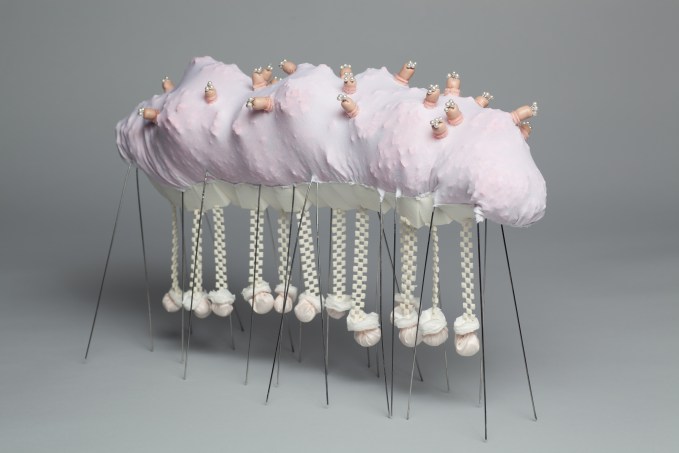
No Shame in Wanting-largeNo Shame in Wanting, 18” x 26” x 10”, 2016, erasers, nylon stockings, cosmetic wedges, no-slip rug mat, diapers, women’s slip, pillow stuffing, ear plugs, sewing pins, hair curlers, egg whiskers
Through repetitious processes that reference “women’s work,” I transform implements of domesticity into startling, otherworldly forms. These biomorphic sculptures oscillate between dream and nightmare, mimicking known life—such as sea life and reproductive organs—while remaining alien.
My sculptures transform everyday detritus—loaded with social assumptions about gender and class roles—into bursting, unknown life, complete with ambiguous new gender classifications and power hierarchies that are full of potential. Unsettling interrogations of feminine stereotypes, they collapse the space between comfort and threat.
Pillowcases, sheer stockings and bath loofahs become bulbous appendages, glistening orifices and billowing innards. Bath mats that once kept human feet dry are re-imagined as vital tentacles used for collecting food.
My work is inspired by an absurd, futuristic vision: Imagine that you leave your household items in the woods with a group of women for five million years and, through their simple labor, the women evolve these items into evocative, feminine oddities, a marriage of wild and domestic.
Propelled by this vision, I dissect and reconstruct household accoutrements into fantastic and psychological sculptural organisms. My work anticipates a sensual, soft-edged world, punctuated by a ‘post-metamorphosis’ of gender roles.
—Meg Stein, 2016
Meg Stein is a sculptor, animator and installation artist from Durham, NC. Most recently her work has been exhibited in Portland (OR), South Carolina, Louisiana, North Carolina, Atlanta, Brooklyn, and Philadelphia. In 2016 she was in residence at Yaddo in Saratoga Springs, NY. She has been an Artist-in-Residence at the Atlantic Center for the Arts in New Smyrna Beach, FL (2014), at “Wetland” by Mary Mattingly in Philadelphia’s FringeArts (2014), a Regional Emerging Artist-in-Residence at Artspace in Raleigh, NC (2014), a resident artist at the Virginia Center for the Creative Arts in Amherst, VA (2015) and an Artist-in-Residence at the Indie Grits Film Festival in Columbia, SC (2015).  She was a participant in New York Arts Practicum in 2014, working with Simone Leigh. In 2012 she won the David A. Dowdy Jr. Award for Sculpture, was nominated for the International Sculpture Center’s Outstanding Student Achievement in Contemporary Sculpture Award (2014), won a merit scholarship for the Ox-Bow School of Art in Saugatuck, MI (2014) and won 3rd place in the National Compact Competition at Louisiana State University in Baton Rouge, LA (2015). She earned her MFA in Studio Art from UNC Chapel Hill in 2014. More information is available at megstein.com. You can contact her at meg.stein.artist@gmail.com.