Be “in touch” and visit Friday, April 15th, 6-9pm, for Danielle McCleave’s solo exhibition.
Read the conversation between her and Sibley Barlow, our writer-in-residence about the show.
Danielle McCleave is a young artist wrapping up her final moments with Belmont College of Visual Arts. Her current installation work explores themes of personal space, intimacy, and human interaction. In her upcoming show, viewers will no longer be viewers, but agents of an event. Danielle is setting up a space for us to engage with one another in a way that reaches beyond our everyday interaction. Below is a slightly condensed interview with the artist discussing her thesis exhibition at Ground Floor Gallery.
S: Well first of all, let’s hear about your piece. Can you explain how the idea originated?
D: My piece is basically a commentary on touch, and the personal space bubble of humans in our society. About two semesters ago I studied abroad in Italy, the fall semester of my junior year. I just really realized how small their personal space bubble is there, compared to ours here in America – which is really interesting to me. I was walking down the streets, and first of all, the sidewalks are really small there anyway, everything is small there, it’s just a tiny place. And you’re on this small sidewalk and people are just passing by you like “School’s out, school’s out!” and they bump you and touch you and they greet you with a kiss. And there’s not really a concept of a line, but it doesn’t bother anyone. Everyone kind of just touches each other and they will talk to you up close; that is their space. It’s just a different in comparison to America. We’re very distant to the point of being sterile, and I think that is hindering us a little bit especially in childcare. I nanny a lot, and so that’s where a lot of my ideas come from. Kids in America, like in a kindergarten class, if a one of them falls over I can’t kiss his boo boo because it’s “gross.” But of course, I mean, it’s a child. But the precautions and the ideas have been perverted in our society. At a baseline it’s become a little too sterile, in my opinion. I at least wanted people to realize how different it is from other places in the world. So with my piece I want to, kind of, break that bubble, in a fun and interactive way. And I like my work to be very open, I never want it to feel cut off. For example, one of the things I absolutely love is touching art. I like my art to be touched, even if at some point in the future it will physically destroy my art I think it would have been for the benefit, because at least it was able to be interacted with.
S: Did this idea hit you while in Italy experiencing that?
D: No. I just woke up one morning, like 6 in the morning and sketched this out in my sketchbook, went back to sleep, and never thought about it again until I was told that I needed to get a start on this thesis. So I just went back and worked off of that. My very first project was to have a very dark room that would have finger-like extensions or little things that would touch you and it could give the sensation of gently being touched or caressed. That evolved into this piece with the hanging balls because I wanted each finger or extension to light up as if it were your neurons lighting up when you touched them, you know, and so that’s what that turned into. I made this sort of hallway and so you can see people going through it, walking through it, but also be a part of it in the same way. The other part is a wall with thermochromatic paint so you can see your handprint, your touch on a surface, to make it sort of physical – that which normally can’t be seen. The way you touch someone and what that feels like. As if every time you touched someone, it left a handprint on their body. So I made a wall and two platforms on the ground so if you were to take off your shoes and walk on it you could see your footprints. The fourth piece is basically a giant touch lamp and it’s sort of a closet/hallway, but it’s open, and metal on all four sides. Viewers will walk inside of it but everytime you touch a side, the light will go on and off, so you can squeeze by a bunch of people in a crowd and the light will on and off.
S: And it’s going to force people to also touch each other?
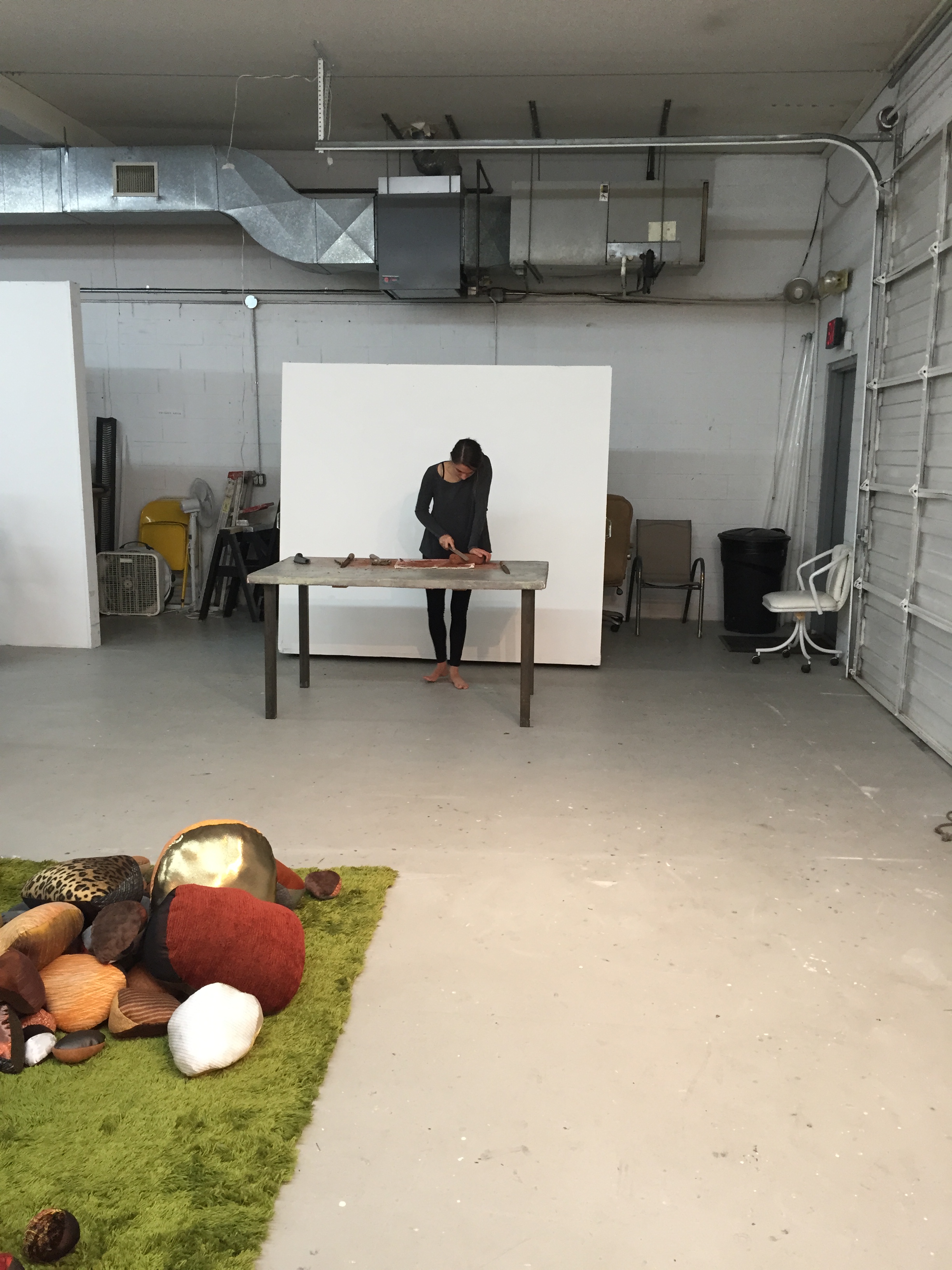
D: Yes, that’s the goal. I also have another piece that is a performance piece which I am actually shooting today, and that will just show basically the same concept of visualizing our touch on people around us – using color. Each person will have a particular color and when you touch someone they get a little bit of that color, you know? That will be projected on the wall.
S: Well I’m pretty excited to see this become a reality.
D: It’s exciting but terrifying, like anything else in art. I’ve been working on this for over a year now, so we’ll see.
S: So around this time last year you started on it?
D: Yeah, I’d say so. Maybe a little earlier. I’ve been forming this piece and trying to kind bring it to life. I always feel a kinship to God in art, in that we are able to create the way God has created so we get that same experience. Artists have that same job that God fulfills. (Laughs) It is true though. It is that gift to create and make things that are brand new which is cool you know?
S: Do you find that there is spirituality in your work? Not necessarily religion but that essence of a bigger presence?
D: Yeah, I try to definitely try to have some sort of spirituality. I have a sense of at least some form of spirituality in there, partially because I do identify as Christian. I usually try to get a lot of my motivation from the religious environment. I’m a little bit of a liberal christian so I turn to nature often. I really listen to the environment and everything that surrounds me. I feel like just that spirit, listening to the world happening around us and trying to wake people up to it and draw their attention to it is what comes out in my art. At least what I want to bring out. Opening eyes to the every day of what’s around us.
S: What was your childhood experience with art like? When did you know you wanted to be an artist?
D: I was always doodling and painting. But my dad is an engineer, my mom is a teacher. My mom was always very open to it and encouraged it in me. My dad as well, but he took it more to the engineering direction. I just knew I always liked painting but I never thought of it as a career until maybe high school when I took architecture. That was more because I was thinking of the financial security of it. But when I took the class I realized how much I hate sitting there drawing straight lines. It just got really boring. My senior year I ended up winning some drawing competitions, and that encouraged me. But it was something I just had to figure out that I wanted over time and just sort of forget everything else, dive in, and make it happen.
S: Is there a part of you that is still interested in architecture? You’re pretty focused on installation work, and this piece in particular is pretty architectural.
D: No, well maybe.
S: Because you are obviously focused on people, but does the space they inhabit have significance as well?
D: I find fascination in architecture and the beauty of it. But I don’t think I would ever want to be the person behind it, designing it. I do love it on a small scale, with the installation work. I don’t have set media for my art, I just start with an idea, and then I need a way to explain it. So I pick media that suits it from that point. Sometimes it’s painting, sometimes it’s photography, sometimes it’s an installation. My concentration is on the idea. Which I also find very freeing, I don’t have to be stuck behind the stigma of, say, a photographer. That works for some people, but I’m just going to do it all, and everyone will have to be okay with it.
S: So you’re from Orlando, and you lived there for quite a while I’m assuming?
D: I lived there for the first part of my life, and then I moved to Dallas TX. Always lived in the city, always been around people. Nashville is the smallest city I’ve ever lived in. I work downtown, I love the energy of the city and being around a crowd but at the same time open space and nature. Which is interesting because that’s not what I was brought up in.
S: So what sort of influence do you think that has had on your art – being around that community?
D: I think it does have a lot to do with it. Being around that many people of different cultures and the realities of that. I never knew a stranger growing up with my mom, because that’s just how she is, everyone on the street is a friend. We would pick up random people off the street often and give them rides. I would be a two year old in the car seat next to them saying hello. You talk to everyone, everyone is family. Of course be safe, be cautious, but never assume a person is a stranger to you. I try to show that in my art or at least use it.
S: Use it as a way to connect people and get them back to that point?
D: Yeah definitely. In cities it can be very isolating and very lonely yet at the same time you are surrounded by so many people. But it doesn’t have to be that way, which is interesting. So I try to go the opposite direction, you can either embrace everyone and deal with all that energy, or let yourself be isolated. And I obviously do need that space at times to be by myself, but I get energy from people.
S: So simultaneously being alone while being amongst everyone else – that is a very interesting thing to think about. It’s very human, I think everyone finds comfort in that dynamic.
D: Yeah, it’s a really great paradox.
S: What are you going to do after this? As far as your show goes, do you feel like this will be resolved by the time you’re done with it, or is there more to explore?
D: As of now I feel it’s resolved. Partly because I’ve been working on it for a year now and it’s time to leave it alone. It is also an “assignment” as well so part of me, the rebel in me, wants to reject it for that reason. I do want to explore it more and figure out how to complete it in the way I originally visualized it. Like with any art piece, I go through so many modifications, so many trials and errors, nothing is how it was when I first thought of it. And so it is also wonderful, going through that process. Finding those issues and resolving them, and figuring out that it’s not actually resolved, redoing it, going back over everything, completely erasing it, crying (Laughs). So that process is so important, and I think it’s a really important part of my work to talk about. There are so many pieces out there in the world that have been through so much trauma in order to get out into the world, and I love that. So I think I can still go deeper into it, but not right off. I may do something else for a little while and come back to the idea at a different time, reassess, see if I even still believe in it.




 Ground Floor Gallery + Studios